Finding the Best Web Hosting for beginners in 2026 can feel overwhelming—especially when every provider claims to be the fastest, cheapest, and most reliable. But once you start comparing plans, the reality hits: hidden pricing, confusing features, and unclear performance promises.
After working with multiple hosting platforms for both personal blogs and client websites, one thing becomes obvious—choosing the right hosting early can save you time, money, and a lot of frustration later.
The good news? You don’t need technical expertise to get started. Today’s beginner-friendly hosting solutions are designed to be simple, affordable, and powerful enough to grow with your website.
In this guide, you’ll discover the top hosting providers, real comparisons, and exactly how to choose the right one for your needs in 2026.
What is Web Hosting? (Simple Explanation)
Web hosting is the service that stores your website and makes it accessible online.
Think of it like this:
Your website is your shop, and hosting is the land where it’s built. Without land, your shop simply can’t exist.
Why it matters more than beginners realize:
1. Speed: A slow website drives visitors away within seconds
When someone visits your website, they expect it to load quickly. If it takes more than 2–3 seconds, most users leave without even seeing your content.
Think of it like this: if a shop door takes too long to open, people just walk away.
Faster websites:
- Keep visitors engaged
- Reduce bounce rate
- Increase conversions (sales, sign-ups, etc.)
2. Search Visibility: Faster sites perform better in rankings
Search engines like Google consider website speed as an important ranking factor. A fast-loading site provides a better user experience, so it’s more likely to appear higher in search results.
In simple terms:
Faster website = better chances of ranking higher
This means:
- More organic traffic
- Better visibility
- Higher chances of reaching your target audience
3. User Trust: Downtime damages credibility
Downtime means your website is unavailable. If visitors try to access your site and it’s not working, they may assume your business is unreliable.
Example:
If a customer visits your site and sees an error page, they might never return.
Reliable hosting ensures:
- Your website stays online 24/7
- Visitors trust your brand
- You don’t lose potential customers
From experience, even a well-designed site struggles if the hosting behind it isn’t reliable.
Types of Web Hosting Explained
Not all hosting is the same. Here’s a quick breakdown:
| Hosting Type | Best For | Cost | Difficulty Level |
| Shared Hosting | Beginners, small websites | Low | Easy |
| VPS Hosting | Growing websites | Medium | Moderate |
| Cloud Hosting | Scalable businesses | Medium–High | Moderate |
| Managed WordPress | WordPress users | Medium | Easy |
What beginners should know:
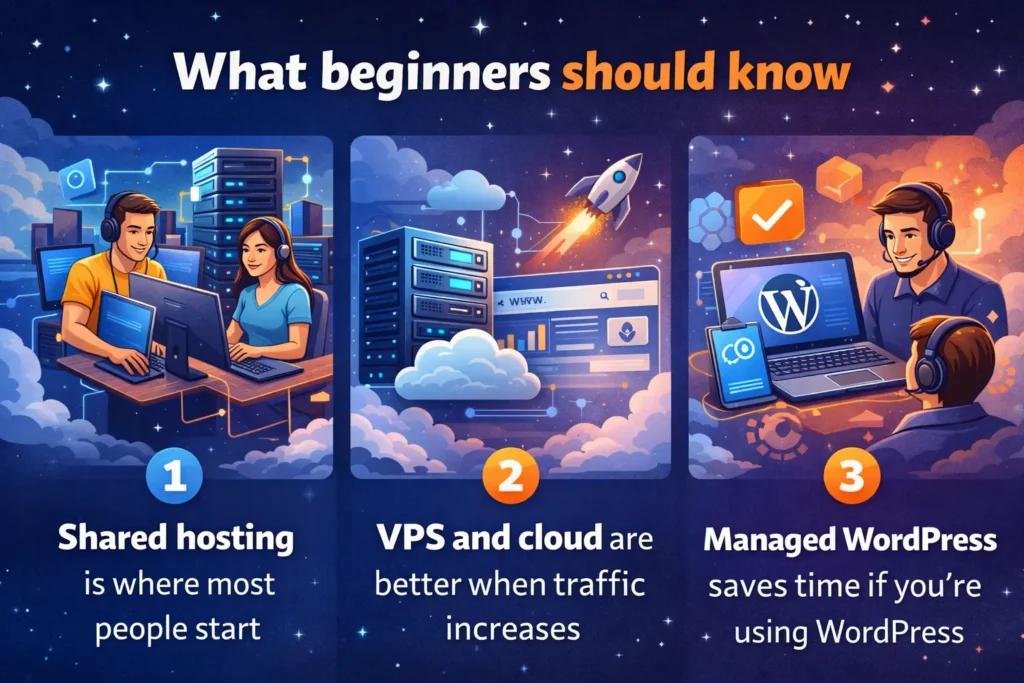
1. Shared hosting is where most people start (and that’s okay)
This means:
- Your website shares a single server with many other websites
- Costs are very low because resources are shared
- Setup is easy and requires no technical knowledge
In simple terms:
It’s like renting a room in a shared apartment—you share space and resources, but it’s affordable and perfect when you’re starting out.
Why it’s okay:
- Ideal for beginners
- Enough for blogs, portfolios, and small business sites
- You can always upgrade later
2. VPS and cloud are better when traffic increases
This means:
- As your website grows and gets more visitors, shared hosting may slow down
- VPS and cloud hosting give you more power, speed, and stability
Simple analogy:
- Shared hosting: Shared apartment
- VPS: Your own private apartment
- Cloud hosting: Multiple apartments combined for flexibility
Why it matters:
- Handles more visitors without crashing
- Faster loading times
- Better performance for SEO and user experience
3. Managed WordPress saves time if you’re using WordPress
This means:
- The hosting provider takes care of technical tasks like:
- Updates
- Security
- Backups
- Performance optimization
Simple analogy:
It’s like hiring a maintenance team for your house—you don’t have to fix things yourself.
Why it’s useful:
- No technical stress
- Faster setup
- Optimized specifically for WordPress websites
If you’re launching your first site, keep it simple—you can always upgrade later.
Key Features That Actually Matter
After testing multiple providers, these are the features that truly make a difference:
✔ Ease of Use
A clean dashboard saves hours of frustration. Custom panels (like Hostinger’s) are often easier than traditional ones.
✔ Free Domain & SSL
This helps you save money and improves website security from day one.
✔ Speed & Uptime
Look for at least 99.9% uptime. Anything less can impact your growth.
✔ Customer Support
When something breaks (and it will), fast support matters more than anything.
✔ One-Click Installation
Especially useful for WordPress—this can save hours of setup time.
✔ Transparent Pricing
Introductory pricing is often low, but always check renewal costs.
Top Beginner-Friendly Hosting Providers (2026)
Quick Comparison
| Hosting Provider | Starting Price | Uptime | Free Domain | Best For |
| Bluehost | Affordable | 99.9% | Yes | First-time users |
| Hostinger | Very Low | 99.9% | Yes | Budget-friendly start |
| SiteGround | Medium | 99.99% | Yes | Support & reliability |
| A2 Hosting | Medium | 99.9% | No | Speed-focused sites |
| DreamHost | Affordable | 99.9% | Yes | Long-term projects |
Honest Reviews Based on Real Usage
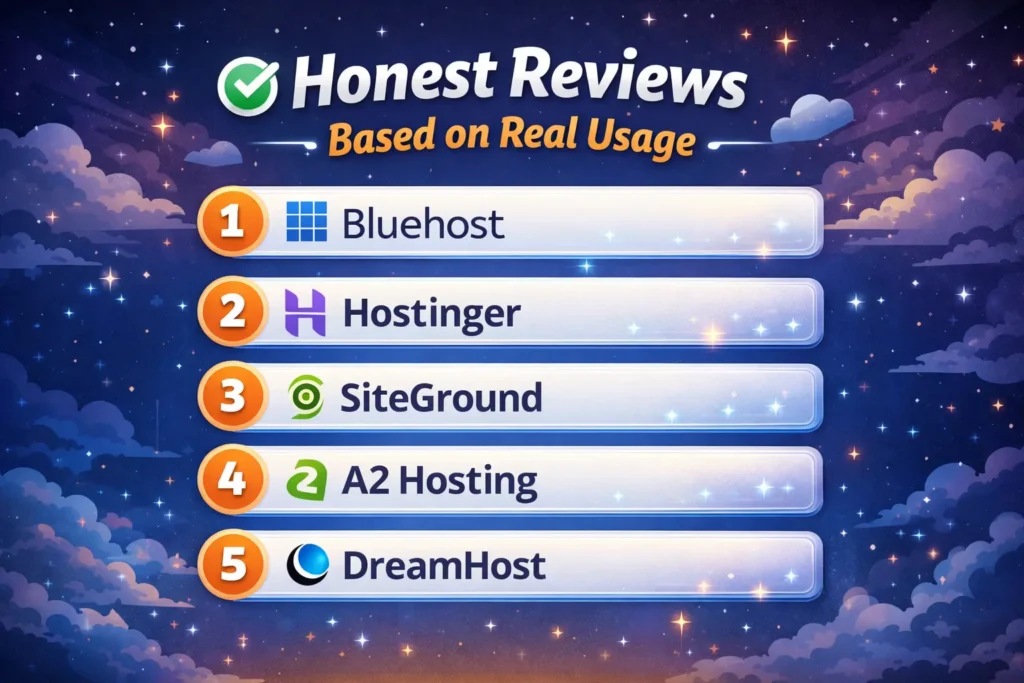
1. Bluehost – Best Overall for Beginners
Bluehost is often the first choice for beginners—and for good reason. The setup process is extremely simple, and everything is designed for non-technical users.
What stands out:
- Seamless WordPress setup
- Clean and beginner-friendly interface
- Reliable uptime
Where it could improve:
- Renewal pricing is higher than the starting plan
Best for: Anyone launching their first blog or website
2. Hostinger – Best for Budget Users
Hostinger offers one of the lowest entry prices in the market without compromising too much on performance.
What I noticed:
- Surprisingly fast for the price
- Very intuitive dashboard (great for beginners)
Limitations:
- Fewer advanced features compared to premium providers
Best for: Students, freelancers, and small projects
3. SiteGround – Best Support Experience
If you value support, SiteGround is one of the most reliable options available.
Strengths:
- Fast and knowledgeable support team
- Strong performance consistency
Drawback:
- Slightly more expensive than others
Best for: Business owners who want peace of mind
4. A2 Hosting – Best for Speed
Speed can make a big difference, especially for SEO and user experience.
Highlights:
- High-speed servers
- Good performance under load
Consideration:
- Premium plans are required for best performance
Best for: Websites focused on performance and growth
5. DreamHost – Best for Long-Term Value
DreamHost keeps things simple and transparent—something many beginners appreciate.
Key advantages:
- No aggressive upselling
- Long money-back guarantee
Minor downside:
- Interface takes some time to get used to
Best for: Bloggers and long-term website owners
Pricing Comparison (What You’ll Actually Pay)
| Provider | Intro Price | Renewal Price | Money-Back Guarantee |
| Bluehost | Low | Medium | 30 Days |
| Hostinger | Very Low | Medium | 30 Days |
| SiteGround | Medium | High | 30 Days |
| A2 Hosting | Medium | Medium | 30 Days |
| DreamHost | Low | Low | 97 Days |
Quick Pros & Cons Summary
1. Bluehost – Easy to use but higher renewals
- Easy to use: The dashboard is simple, setup is quick, and even non-technical users can launch a site in minutes.
- Higher renewals: The starting price looks cheap, but after the first term, the cost increases.
👉 Meaning: Great for beginners, but plan your budget for long-term costs.
2. Hostinger – Affordable but limited advanced tools
- Affordable: One of the cheapest options to start a website.
- Limited advanced tools: It may lack some high-end features (like advanced server control or staging tools).
👉 Meaning: Perfect for small projects, but may feel limited as your website grows.
3. SiteGround – Excellent support but premium pricing
- Excellent support: Fast, helpful, and knowledgeable customer service (very useful for beginners).
- Premium pricing: Costs more than most competitors, especially after renewal.
👉 Meaning: You’re paying extra for peace of mind and support quality.
4. A2 Hosting – Fast but slightly expensive upgrades
- Fast: Known for speed (especially with “Turbo” plans), which helps SEO and user experience.
- Expensive upgrades: To unlock full speed benefits, you often need higher-priced plans.
👉 Meaning: Good for performance, but best features are not in the cheapest plan.
5. DreamHost – Transparent but less intuitive UI
- Transparent: No hidden pricing tricks, clear plans, and fair policies.
- Less intuitive UI: The dashboard is different from common ones like cPanel, so it may take time to learn.
👉 Meaning: Honest pricing, but slightly harder to get used to initially.
Best Hosting Based on Use Case
| Use Case | Recommended Provider |
| Blogging | Bluehost |
| Budget Users | Hostinger |
| Small Business | SiteGround |
| Speed | A2 Hosting |
| Long-Term Projects | DreamHost |
How to Choose the Right Hosting
Choosing the right hosting doesn’t have to be complicated—especially if you focus on what actually matters instead of getting distracted by unnecessary features.
Start by asking yourself:
- What is my budget right now?
- Am I building a blog, business website, or an online store?
- How much traffic do I realistically expect in the next 6–12 months?
From experience, most beginners either overspend on features they don’t need or choose extremely cheap plans that hurt performance later.
A smarter approach:
Start with a reliable basic plan and upgrade as your website grows. This way, you avoid wasting money while still leaving room for future expansion.
Quick decision checklist:
- Choose shared hosting if you’re just starting
- Prioritize ease of use over advanced features
- Make sure support is available when you need it
- Always check renewal pricing before buying
Remember: The right hosting provider is not the most expensive one—it’s the one that fits your current needs and can scale with you.
Mistakes Beginners Often Make
Many first-time website owners fall into common traps when choosing a hosting plan—and these mistakes can cost both time and money.
Here’s where most beginners go wrong:
- Choosing the cheapest plan without checking performance:
It may look like a great deal, but slow speed and poor uptime can hurt your website’s growth. - Ignoring renewal costs:
Many hosting providers offer low introductory prices, but renewal rates are often much higher. - Overlooking customer support quality:
When your site faces issues, slow or unhelpful support can become a major problem. - Buying unnecessary add-ons:
Features like extra security or backups are useful—but many beginners end up paying for things they don’t actually need.
From experience, one smart hosting decision at the beginning can save you months of frustration and unexpected costs later.
Conclusion
Starting a website in 2026 doesn’t have to be complicated—the real key is choosing the right hosting provider that matches your goals and budget from day one.
If you’re looking for the best web hosting experience as a beginner, Bluehost is a reliable all-round choice, while Hostinger is perfect if you want to keep costs low. For those who value premium support, SiteGround is worth the investment, and A2 Hosting is a strong option if speed is your top priority.
If you’re still unsure, start simple—Bluehost is the safest choice for most beginners.
From experience, the biggest mistake is waiting too long to decide. The longer you delay, the more opportunities you miss.
Choose your hosting, launch your website, and start building today.
Because in the online world, action beats perfection every time.
Frequently Asked Questions (FAQs)
1. Which hosting is best for beginners in 2026?
For most beginners, Bluehost and Hostinger offer the best balance of simplicity, affordability, and performance.
2. Is free hosting worth it?
Free hosting comes with limitations like ads, poor performance, and lack of support. It’s not ideal for serious websites.
3. How much should I expect to spend?
Beginner plans are usually affordable, especially with introductory offers, but always check renewal pricing.
4. Can I switch hosting later?
Yes, most providers offer migration options, and some even handle it for free.
5. Do I need coding knowledge to start?
No, modern hosting platforms are designed for beginners with simple interfaces and one-click setups.