Mohammed Wasim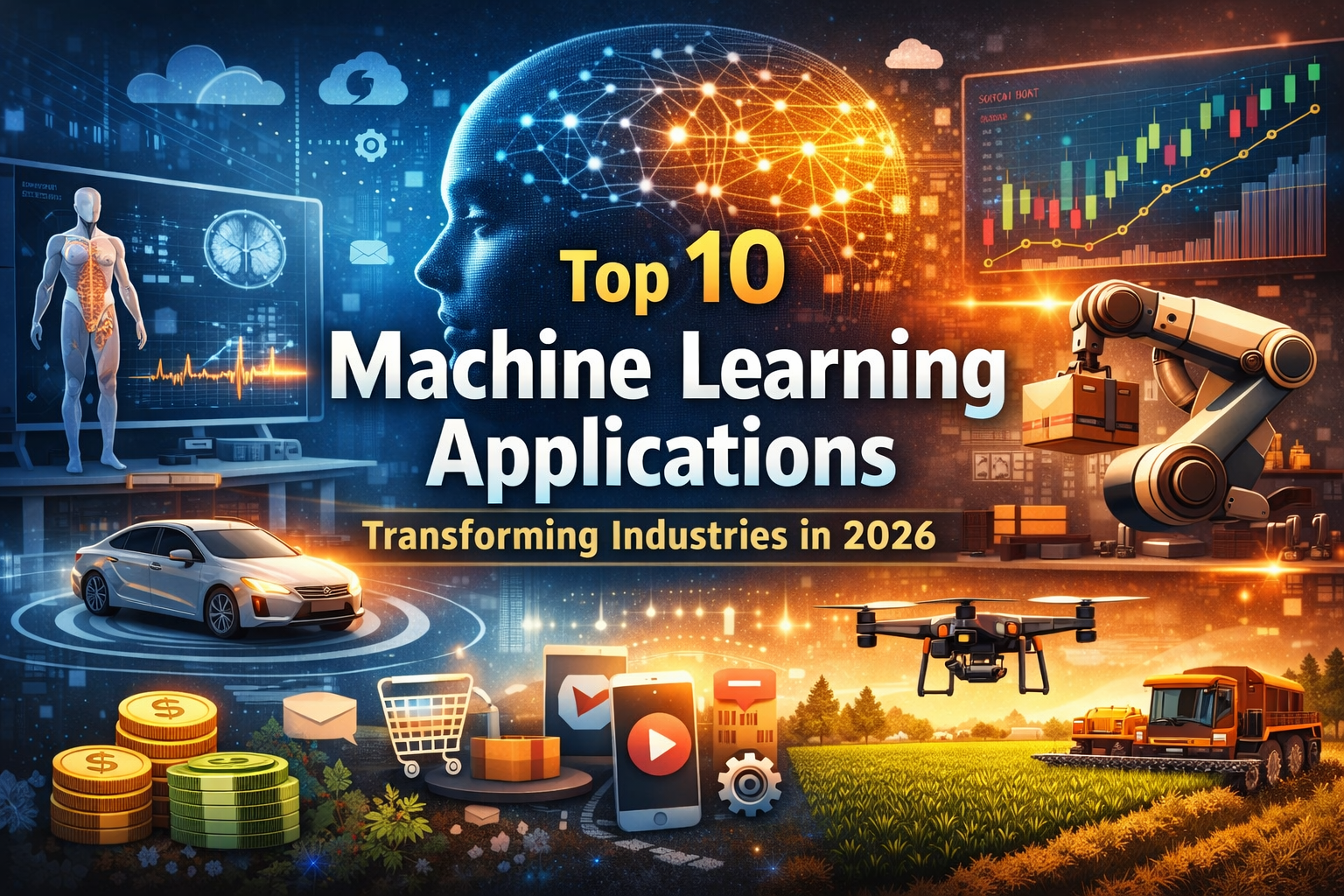
Take a moment to think about how often you interact with technology in a single day. From unlocking your phone with face recognition to receiving personalized recommendations on shopping apps, there’s a high chance that Machine Learning is working quietly behind the scenes.
In 2026, technology is no longer just supporting industries, it is redefining them. At the center of this transformation lies Machine Learning, a powerful branch of artificial intelligence that enables systems to learn from data and improve over time without explicit programming. Alongside it, Deep Learning and Natural Language Processing are unlocking capabilities that once seemed impossible.
What makes this transformation even more powerful is the combination of Deep Learning and Natural Language Processing (NLP). While Machine Learning helps systems learn from data, Deep Learning enables them to process complex information like images and videos, and NLP allows them to understand human language.
Together, these technologies are not just improving efficiency—they are fundamentally changing how industries operate.
In this in-depth guide, we’ll explore the top 10 Machine Learning applications in 2026, along with real-world insights, practical use cases, and why they matter more than ever.
Understanding Machine Learning, Deep Learning, and NLP (Simplified)
Before we jump into applications, let’s simplify the basics in a way that actually makes sense.
Machine Learning: is all about teaching computers to learn from data. Instead of programming every rule manually, we feed data into algorithms so they can identify patterns and make decisions.
Deep Learning: a subset of Machine Learning, takes things further. It uses neural networks (inspired by the human brain) to analyze complex data such as images, videos, and speech. This is what powers technologies like facial recognition and self-driving cars.
Natural Language Processing (NLP): focuses on language. It allows machines to understand, interpret, and respond to human communication—whether it’s text or voice.
A simple real-world example:
When you ask a voice assistant a question:
- NLP understands your words
- Deep Learning interprets the meaning
- Machine Learning improves future responses
This combination is what makes modern AI systems so powerful.
Why Machine Learning Matters More Than Ever in 2026
We are living in a data-driven world. Every click, search, purchase, and interaction generates data. But raw data alone is useless unless it can be analyzed and turned into actionable insights.
That’s where Machine Learning becomes essential.
Here’s why its importance has grown rapidly:
- Businesses need faster decision-making
- Automation reduces manual work and costs
- Customers expect personalized experiences
- Competition demands innovation and efficiency
In fact, many companies today are integrating Machine Learning into their core operations—not as an option, but as a necessity.
Top 10 Machine Learning Applications in 2026
1. Healthcare & Medical Diagnosis
If there’s one industry where Machine Learning is making a life-changing impact, it’s healthcare.
Doctors today are supported by intelligent systems that can analyze medical data far more quickly than humans. For example, ML-powered tools can examine thousands of medical images in seconds to detect early signs of diseases like cancer.
Deep Learning plays a crucial role here by improving the accuracy of image recognition in scans like MRIs and CT scans. Meanwhile, NLP helps process patient records, prescriptions, and clinical notes.
What’s truly remarkable is the shift toward predictive healthcare. Instead of treating diseases after they occur, Machine Learning helps identify risks early, allowing preventive care.
This doesn’t replace doctors—it enhances their ability to make better decisions.
2. Finance & Fraud Detection
Financial systems handle millions of transactions every second. Detecting fraud manually would be nearly impossible.
Machine Learning solves this problem by analyzing patterns in real time. If a transaction seems unusual—like a sudden purchase in a different country—the system can flag it instantly.
Banks and fintech companies use ML for:
- Fraud detection
- Credit scoring
- Risk management
- Algorithmic trading
Deep Learning models can even detect subtle patterns that traditional systems might miss, making financial systems more secure and reliable.
3. E-commerce & Personalization
One of the most visible uses of Machine Learning is in e-commerce.
Think about how platforms recommend products. It often feels like they understand your preferences better than you do. That’s because ML algorithms analyze your browsing history, purchase behavior, and even the time you spend looking at certain products.
Key applications include:
- Personalized recommendations
- Customer segmentation
- Dynamic pricing
- Inventory management
NLP also plays a role by analyzing customer reviews and feedback to improve products and services.
This level of personalization not only improves user experience but also significantly increases sales.
4. Autonomous Vehicles
Self-driving cars are one of the most exciting examples of Machine Learning in action.
These vehicles rely on a combination of technologies:
- Deep Learning for object detection
- Sensors and cameras for real-time data
- ML algorithms for decision-making
For instance, a self-driving car must recognize pedestrians, interpret traffic signals, and predict the behavior of other vehicles—all in real time.
Even though fully autonomous driving is still evolving, many modern cars already use ML-powered features like adaptive cruise control and lane assistance.
5. Marketing & Customer Insights
Marketing has evolved from intuition-based decisions to data-driven strategies.
Machine Learning allows businesses to understand their customers at a deeper level. Instead of targeting a broad audience, companies can now create highly personalized campaigns.
Applications include:
- Predicting customer behavior
- Targeted advertising
- Email personalization
- Customer journey analysis
NLP-powered chatbots have also transformed customer support by providing instant responses and improving user engagement.
The result is more efficient marketing and higher conversion rates.
6. Manufacturing & Automation
Manufacturing is becoming smarter and more efficient with Machine Learning.
One of the biggest advantages is predictive maintenance. Instead of waiting for machines to fail, ML models can predict when maintenance is needed, reducing downtime and costs.
Other applications include:
- Quality control using computer vision
- Robotics automation
- Supply chain optimization
Deep Learning ensures high accuracy in detecting defects, while ML models improve operational efficiency.
7. Education & Personalized Learning
Education is no longer limited to traditional methods.
Machine Learning is enabling personalized learning experiences tailored to individual students. Instead of a one-size-fits-all approach, systems can adapt based on a student’s progress and learning style.
Examples include:
- AI tutors providing instant feedback
- Adaptive learning platforms
- Automated grading systems
NLP helps in understanding student queries, making interactions more natural and effective.
8. Cybersecurity & Threat Detection
As digital threats become more advanced, traditional security measures are no longer enough.
Machine Learning enhances cybersecurity by detecting unusual patterns and identifying potential threats before they cause damage.
Key applications:
- Anomaly detection
- Malware identification
- Real-time threat monitoring
What makes ML powerful here is its ability to learn continuously, adapting to new threats as they emerge.
9. Media & Content Creation
The way content is created and consumed has changed dramatically.
Machine Learning is now used to:
- Generate content (text, images, videos)
- Recommend personalized content
- Analyze audience engagement
Streaming platforms use ML algorithms to suggest movies and shows, while creators use AI tools to produce content faster.
NLP helps analyze tone, sentiment, and context, making content more relevant and engaging.
10. Agriculture & Smart Farming
Even agriculture is benefiting from advanced technologies.
Farmers are using Machine Learning to make smarter decisions based on data rather than guesswork.
Applications include:
- Crop yield prediction
- Weather analysis
- Soil monitoring
- Pest detection
These innovations help increase productivity and reduce resource wastage, making farming more sustainable.
Also know more about:
Best productivity tools in 2026
Trending AI powered gadgets in 2026
Key Benefits of Machine Learning
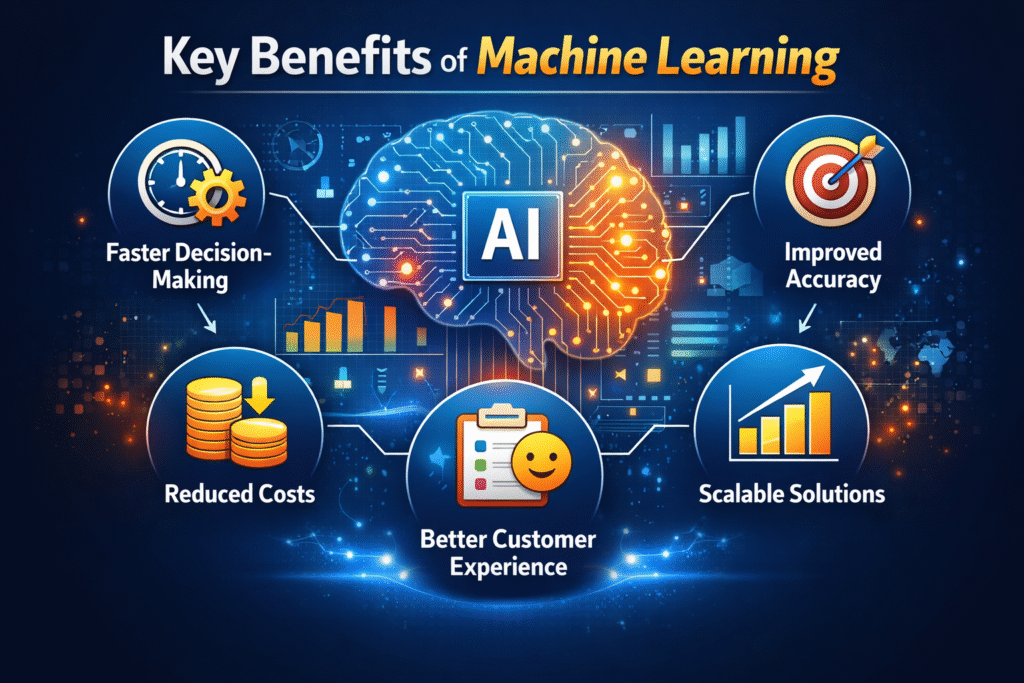
Across industries, the benefits are clear:
- Faster decision-making
- Improved accuracy
- Reduced costs
- Better customer experiences
- Scalable solutions
1. Faster Decision-Making
One of the biggest advantages of Machine Learning is speed. In today’s fast-paced digital world, businesses cannot afford to wait hours or even minutes to make important decisions.
Machine Learning models can process massive amounts of data in real time and provide instant insights. For example, in the finance sector, fraud detection systems analyze transactions within seconds and flag suspicious activity immediately.
Instead of relying on manual analysis, companies can now make data-driven decisions instantly, which improves efficiency and reduces delays. This speed becomes a major competitive advantage, especially in industries like e-commerce, healthcare, and marketing.
2. Improved Accuracy
Humans can make mistakes, especially when dealing with large and complex datasets. Machine Learning reduces this risk by identifying patterns and trends with high precision.
For instance, in healthcare, ML-powered diagnostic systems can analyze medical images more accurately than traditional methods in certain cases. Similarly, in manufacturing, computer vision systems detect defects in products with near-perfect consistency.
As Machine Learning models are trained on more data, their accuracy improves over time. This continuous learning process ensures better predictions, fewer errors, and more reliable outcomes.
3. Reduced Costs
At first glance, implementing Machine Learning might seem expensive. However, in the long run, it significantly reduces operational costs.
By automating repetitive tasks, businesses can minimize the need for manual labor.
For example:
- Chatbots reduce customer support costs
- Predictive maintenance prevents expensive machine breakdowns
- Automated data analysis saves time and resources
Instead of reacting to problems after they occur, Machine Learning helps businesses prevent issues before they happen, which leads to major cost savings.
4. Better Customer Experiences
Customer expectations have changed dramatically in recent years. People now expect personalized, fast, and seamless interactions and Machine Learning makes this possible.
From personalized product recommendations to instant chatbot support, ML helps businesses understand customer behavior and preferences at a deeper level.
For example:
- Streaming platforms recommend content based on your viewing history
- E-commerce sites suggest products tailored to your interests
- Chatbots provide instant responses 24/7
These personalized experiences not only improve customer satisfaction but also increase loyalty and conversions.
5. Scalable Solutions
As businesses grow, managing operations manually becomes increasingly difficult. Machine Learning offers scalable solutions that can handle growing data and user demands without compromising performance.
Whether a company has 1,000 users or 1 million users, ML systems can adapt and scale accordingly.
For example:
- Recommendation systems can serve millions of users simultaneously
- Fraud detection systems can monitor global transactions in real time
- Marketing tools can analyze large customer datasets effortlessly
This scalability allows businesses to expand without worrying about operational limitations, making Machine Learning a future-proof investment.
When combined with Deep Learning and NLP, Machine Learning becomes even more impactful.
Challenges of Machine Learning
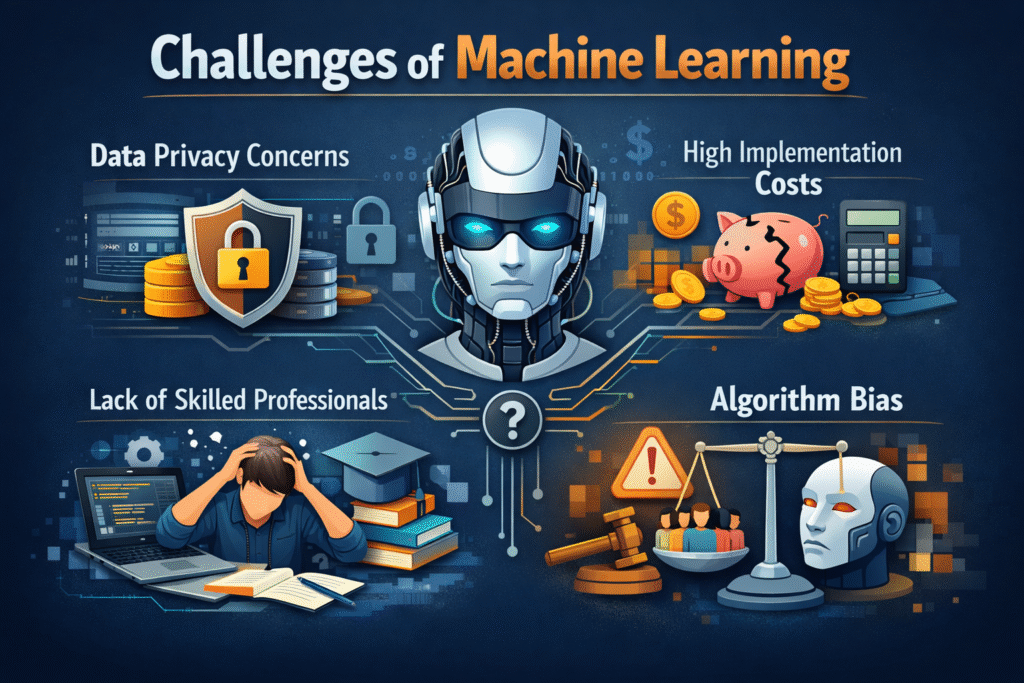
Despite its advantages, there are challenges to consider:
- Data privacy concerns
- High implementation costs
- Lack of skilled professionals
- Algorithm bias
1. Data Privacy Concerns
One of the biggest concerns around Machine Learning today is data privacy.
Machine Learning systems rely heavily on data—often large volumes of personal, sensitive, or behavioral information. This includes things like browsing habits, financial transactions, health records, and even voice data.
The problem arises when:
- Data is collected without clear user consent
- Personal information is stored insecurely
- Systems are vulnerable to data breaches
For example, healthcare systems using ML may process patient records, which are highly sensitive. If this data is not properly protected, it can lead to serious privacy violations.
There’s also growing awareness among users about how their data is being used. People are becoming more cautious, and governments are enforcing stricter regulations.
Why this matters:
If users don’t trust how their data is handled, they won’t trust the system itself.
What’s being done:
- Stronger data protection laws
- Encryption and secure storage
- Transparency in data usage
2. High Implementation Costs
Another major challenge is the cost of implementing Machine Learning systems.
While the idea of AI sounds exciting, the reality is that building and deploying ML solutions can be expensive. Costs typically include:
- Infrastructure (servers, cloud computing)
- Data collection and storage
- Hiring skilled professionals
- Model training and maintenance
For large companies, this investment may be manageable. But for small and medium businesses, it can be a significant barrier.
Even after implementation, costs don’t stop. ML models require:
- Continuous updates
- Monitoring
- Performance optimization
Real-world insight:
Many businesses start with Machine Learning projects but struggle to scale them due to ongoing costs.
What’s improving:
- Rise of cloud-based AI tools
- No-code and low-code ML platforms
- Open-source frameworks
These are slowly making Machine Learning more accessible.
3. Lack of Skilled Professionals
Machine Learning is a highly specialized field, and there is still a shortage of skilled professionals.
Building effective ML systems requires knowledge of:
- Programming (Python, R)
- Statistics and mathematics
- Data analysis
- Model training and optimization
The demand for these skills has grown rapidly, but the supply hasn’t kept up.
What this means for businesses:
- Difficulty hiring experienced talent
- Higher salaries for ML experts
- Slower project execution
What this means for individuals:
This skill gap actually creates an opportunity. People who learn Machine Learning today are entering one of the most in-demand career fields.
How the gap is being addressed:
- Online courses and certifications
- AI learning platforms
- Automation tools that simplify ML workflows
Still, expertise and real-world experience remain critical.
4. Algorithm Bias
One of the most important and often overlooked challenges is algorithm bias.
Machine Learning models learn from data. If the data used for training is biased, the model will also produce biased results.
For example:
- A hiring algorithm trained on biased data may favor certain candidates
- A facial recognition system may perform poorly on certain demographics
- A recommendation system may reinforce stereotypes
This is not because the system is “intentionally unfair,” but because it reflects the data it was trained on.
Why this is a serious issue:
Biased algorithms can lead to:
- Unfair decisions
- Discrimination
- Loss of trust
How companies are addressing it:
- Using diverse and balanced datasets
- Regularly auditing models
- Implementing ethical AI guidelines
Addressing these issues is essential for building trust and ensuring ethical use of AI.
Future of Machine Learning
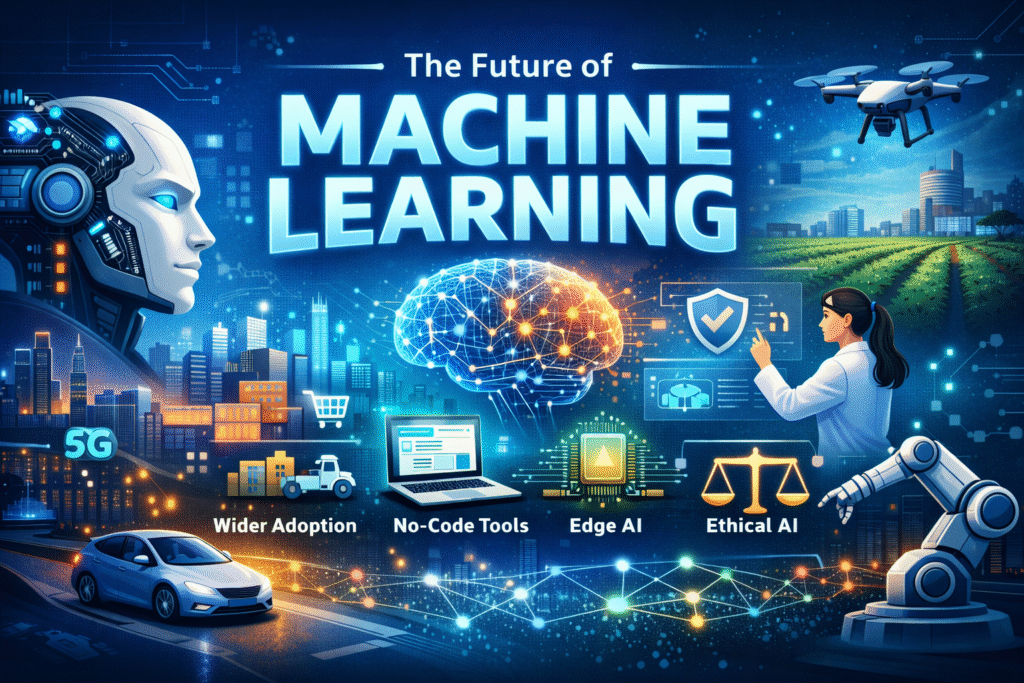
The future of Machine Learning looks incredibly promising.
We can expect:
- Wider adoption across industries
- Growth of no-code ML tools
- Real-time processing with edge AI
- Increased focus on ethical AI
1. Wider Adoption Across Industries
Machine Learning is no longer limited to tech companies or large enterprises. In 2026, its adoption is spreading rapidly across almost every industry, including sectors that traditionally relied on manual processes.
For example, small retail businesses are now using ML tools to predict customer demand, while logistics companies are optimizing delivery routes using intelligent algorithms. Even industries like construction and legal services are beginning to adopt Machine Learning for risk analysis and document processing.
What’s driving this widespread adoption is accessibility. Cloud platforms and ready-to-use AI solutions have made it easier for businesses of all sizes to integrate Machine Learning into their workflows without building everything from scratch.
In simple terms, Machine Learning is becoming as common as using spreadsheets or CRM software, it’s turning into a standard business tool rather than a competitive advantage.
2. Growth of No-Code Machine Learning Tools
One of the biggest shifts happening right now is the rise of no-code and low-code Machine Learning platforms.
Earlier, building ML models required strong programming skills, knowledge of algorithms, and experience with tools like Python and TensorFlow. But today, platforms are emerging that allow users to build and deploy Machine Learning models with little to no coding.
This means:
- Marketers can build predictive models
- Business analysts can forecast trends
- Entrepreneurs can automate processes
all without needing to be data scientists.
These tools typically offer drag-and-drop interfaces, pre-built models, and automated workflows. As a result, Machine Learning is becoming more democratized, allowing non-technical users to leverage its power.
This trend is expected to accelerate, making AI more accessible to startups, freelancers, and small businesses.
3. Real-Time Processing with Edge AI
Traditionally, Machine Learning models relied heavily on cloud computing. Data was sent to centralized servers, processed, and then returned with results. While effective, this approach can cause delays and raise privacy concerns.
This is where Edge AI comes into play.
Edge AI refers to running Machine Learning models directly on devices such as smartphones, IoT devices, or sensors without needing constant internet connectivity.
For example:
- Smart cameras can detect objects instantly
- Wearable devices can monitor health in real time
- Autonomous vehicles can make split-second decisions
The biggest advantage here is speed. Since data is processed locally, there’s minimal latency, making real-time decision-making possible.
Another benefit is privacy, as sensitive data doesn’t need to be sent to external servers.
As devices become more powerful, Edge AI will play a crucial role in enabling faster, safer, and more efficient Machine Learning applications.
4. Increased Focus on Ethical AI
As Machine Learning becomes more powerful, concerns around its ethical use are also growing.
Issues like data privacy, algorithm bias, and lack of transparency have raised important questions about how AI systems should be designed and used.
For instance:
- Biased data can lead to unfair decisions
- Lack of transparency can reduce trust
- Misuse of AI can impact privacy and security
In response, organizations and governments are placing a stronger emphasis on ethical AI practices.
This includes:
- Building transparent and explainable models
- Ensuring fairness in decision-making
- Protecting user data and privacy
- Establishing regulations and guidelines
Ethical AI is not just a technical requirement—it’s becoming a business necessity. Companies that prioritize responsible AI development are more likely to gain trust and long-term success.
As technology evolves, Machine Learning will continue to shape how we live and work.
Conclusion
Machine Learning is no longer something reserved for tech giants or future predictions, it’s already shaping the way the world works in 2026. From smarter healthcare systems to personalized shopping experiences and real-time decision-making, its impact is everywhere.
But what truly makes this moment exciting is not just the technology itself, it’s the opportunity it creates. Businesses are becoming more intelligent, professionals are unlocking new career paths, and even everyday users are benefiting from smarter, faster, and more personalized solutions.
As Deep Learning continues to push the boundaries of what machines can understand, and Natural Language Processing makes human-machine interaction more seamless, we are entering an era where technology feels less like a tool and more like a collaborator.
The real question is no longer “Will Machine Learning change industries?”—it already has.
The real question is: Are you ready to adapt and take advantage of it?
Whether you’re a student exploring new skills, a business owner looking to scale, or a professional aiming to stay relevant now is the perfect time to embrace Machine Learning.
Because in the near future, those who understand and leverage Machine Learning won’t just keep up with change…
they’ll lead it.
Frequently Asked Questions (FAQs)
1. What is Machine Learning in simple terms?
Machine Learning is a technology that enables computers to learn from data and improve performance without explicit programming.
2. How does Deep Learning differ from Machine Learning?
Deep Learning is a subset of Machine Learning that uses neural networks to process complex data like images and speech.
3. What is Natural Language Processing used for?
It is used in chatbots, voice assistants, translation tools, and any system that interacts with human language.
4. Which industries benefit most from Machine Learning?
Healthcare, finance, e-commerce, manufacturing, and cybersecurity are among the top industries.
5. Is Machine Learning a good career in 2026?
Yes, it is one of the most in-demand and high-paying fields with strong growth opportunities.

 Suraj Kumar