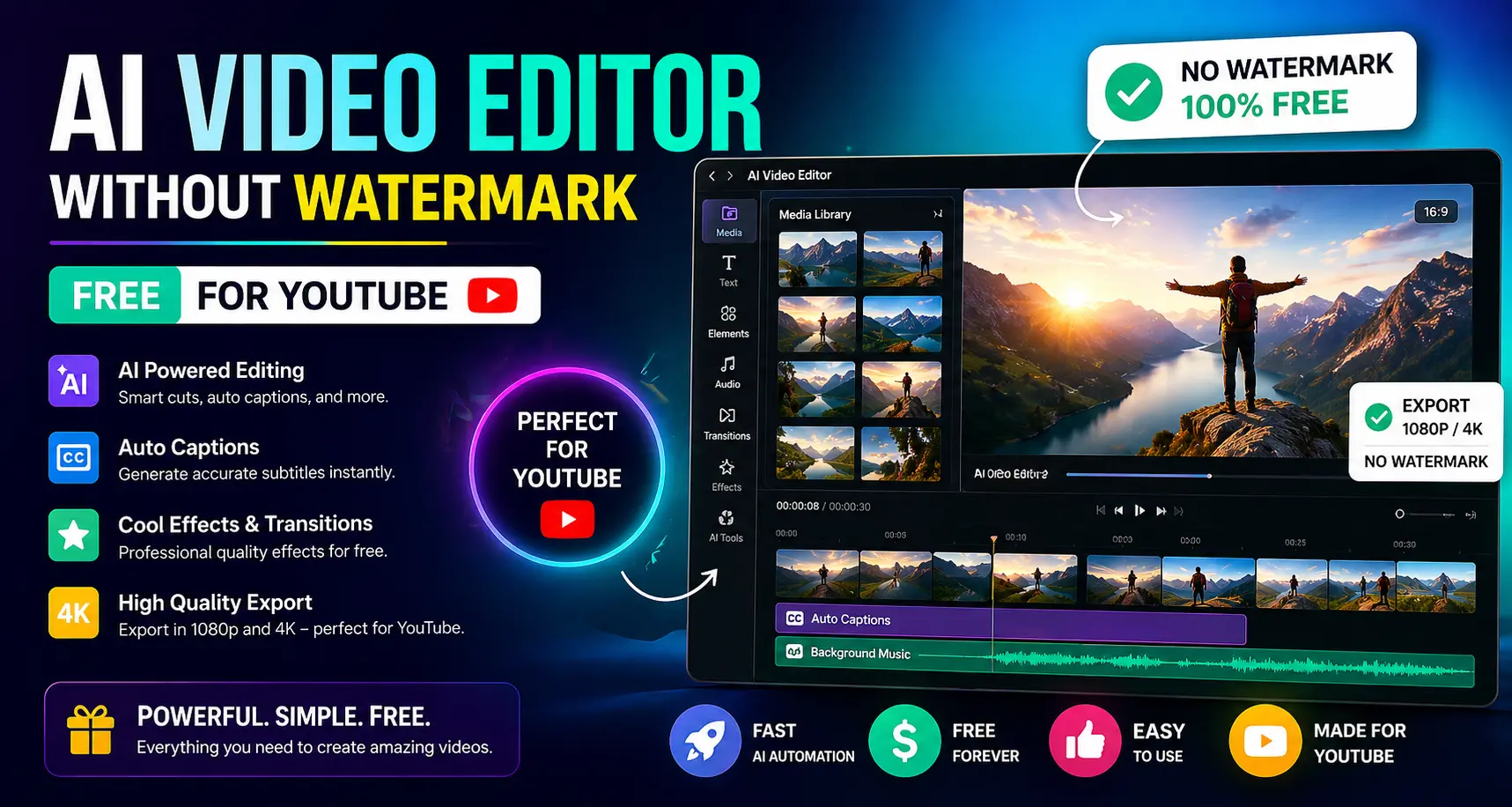
If you’ve ever edited a video using free software, you already know how it goes. You spend time cutting clips, adding music, adjusting everything perfectly… and then the final export hits you with a watermark.
It instantly makes the video look less professional.
For creators trying to grow on YouTube, that’s a serious problem. Whether you’re building a personal brand, running a business channel, or testing content ideas, presentation matters more than ever.
At the same time, video editing itself has changed. AI-powered tools—including AI video editors and AI image generator software—now handle tasks that used to take hours, from cutting clips and generating captions to creating visuals and suggesting transitions.
The best part? You don’t need expensive software to take advantage of this.
In this guide, you’ll find the Free AI video editor options that actually deliver clean exports, along with practical insights to help you choose the right tool based on your workflow—not just features.
What is an AI Video Editor?
An AI video editor is designed to automate repetitive editing tasks and make the entire process faster and more efficient.
Instead of manually trimming footage or syncing subtitles, the software does most of the work for you—often with a single click.
What These Tools Can Do
- Auto-cut & trimming
Detects silence, filler words, and unnecessary pauses—especially useful for talking-head videos and tutorials. - AI subtitles & captions
Generates captions instantly. Studies show videos with captions can improve viewer retention by up to 20–30%, particularly on mobile. - Background removal
Allows you to replace or clean up backgrounds without a green screen setup. - Smart transitions
Suggests transitions based on scene changes, making videos feel smoother without over-editing.
Why Creators Are Moving Toward AI Editing
For beginners, it removes the steep learning curve.
For regular creators, it dramatically reduces editing time.
In practical terms, what used to take 2–3 hours can often be done in under 30 minutes.
Why Choose a Free AI Video Editor Without Watermark?
1. It Keeps Your Content Professional
A watermark instantly reduces perceived quality. Clean visuals help build trust—especially important if you plan to monetize your channel.
2. You Can Start Without Investment
When you’re experimenting with content or just getting started, free tools let you test ideas without financial pressure.
3. Faster Workflow, Less Friction
AI removes repetitive work like trimming, captioning, and syncing. That means more time spent creating—not editing.
4. Better Viewer Experience
Clear visuals, readable captions, and smooth transitions improve watch time. And watch time is one of the biggest factors in YouTube growth.
Top Free AI Video Editors Without Watermark for YouTube (2026)
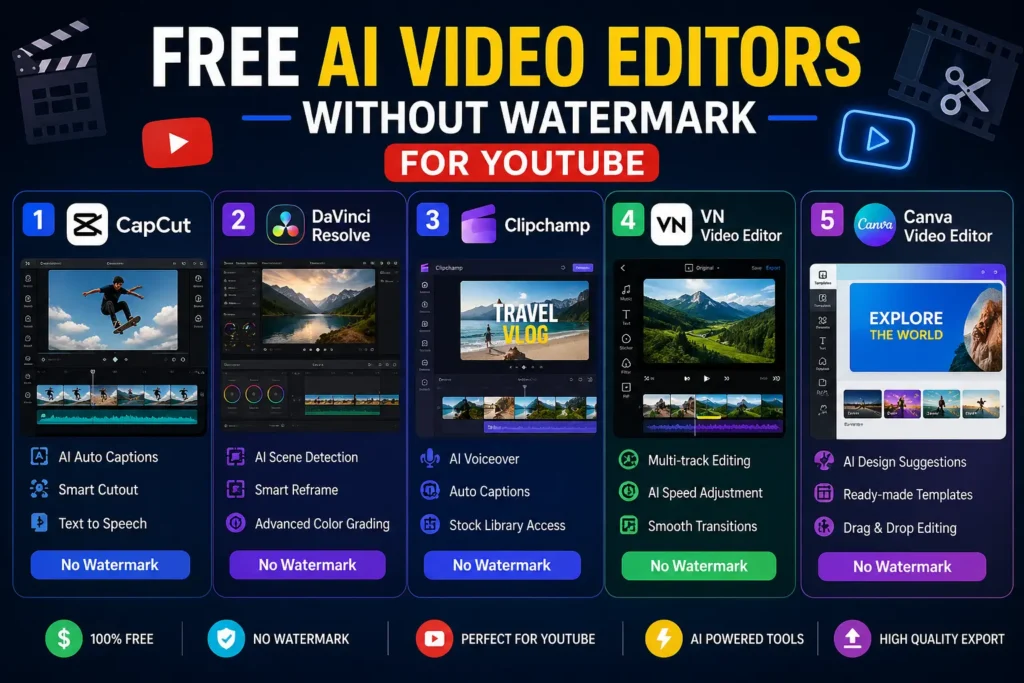
Let’s focus on tools that actually work in real-world scenarios.
1. CapCut
CapCut has quickly become a favorite for short-form creators.
- Accurate auto captions
- Built-in background removal
- Smooth performance across devices
Where it works best:
Short videos, YouTube Shorts, and fast content production.
Where it falls short:
Long-form editing can feel limited compared to professional tools.
2. DaVinci Resolve
A professional-grade editor that’s available for free.
- Advanced color grading tools
- AI-based scene detection and facial recognition
- No watermark on exports
Real-world insight:
It’s powerful—but requires a decent system. On lower-end devices, performance can slow down.
Best fit:
Creators aiming for cinematic or high-production content.
3. Clipchamp
A browser-based editor designed for simplicity.
- AI voiceovers and templates
- No installation required
- Clean, beginner-friendly interface
Why it stands out:
It feels approachable, especially if traditional editing software feels overwhelming.
Limitation:
You may outgrow it as your editing needs become more advanced.
4. VN Video Editor
A solid choice for mobile-first creators.
- No watermark—even in free exports
- Smooth editing experience on smartphones
- Supports multi-layer editing
Ideal for:
Daily vloggers and creators who prefer editing on mobile.
5. Canva Video Editor
Known for design, but surprisingly capable for video.
- AI-assisted templates
- Drag-and-drop simplicity
- Clean exports with minimal limitations
Best use case:
Marketing videos, social content, and branded visuals.
Not built for:
Heavy timeline editing or complex projects.
Comparison Table 1: Best Free AI Video Editing Tools (Quick Overview)
| Tool | Best For | AI Features | Watermark | Platform | Ease of Use |
| CapCut | Shorts & social media | Auto captions, background remover | No (most exports) | Mobile & Desktop | Very Easy |
| DaVinci Resolve | Professional editing | Color correction, scene detection | No | Desktop | Moderate |
| Clipchamp | Beginners | AI voiceover, templates | No (basic plan) | Browser | Very Easy |
| VN Video Editor | Mobile creators | Basic AI tools, smooth editing | No | Mobile | Easy |
| Canva Video Editor | Social & marketing videos | AI templates, design assist | No (limited) | Browser & Mobile | Very Easy |
Key Features to Look for Before Choosing a Tool
1. Watermark-Free Export (Why It Matters More Than You Think)
This is not just about appearance—it directly affects credibility and branding.
Many tools claim to be “free,” but:
- Add a watermark by default
- Remove it only under certain conditions (e.g., lower resolution, limited templates)
- Or require sign-in / trial activation to export clean videos
What to Check Before Using Any Tool
- Export a test video before committing
- Look for hidden conditions (resolution limits, template restrictions)
- Confirm if branding appears only on certain features
Real impact:
A watermark can make your content look reused or unprofessional—especially harmful if you’re trying to monetize or build authority on YouTube.
2. AI Automation (The Real Time-Saver)
This is where modern editing tools truly stand out.
Instead of spending hours manually editing, AI handles repetitive tasks.
Most Useful AI Features
- Auto Captions: Generates subtitles instantly (huge for engagement)
- Scene Detection: Splits clips automatically into usable segments
- Smart Trimming: Removes silence, filler words, or mistakes
Why This Matters
In real workflows:
- A 10-minute video that used to take 2 hours can be edited in under 30–40 minutes
- Consistency becomes easier because editing isn’t a bottleneck
Bottom line:
The more automation a tool offers, the faster you can produce content.
3. Export Quality (Direct Impact on Growth)
Video quality affects how your audience—and YouTube—perceives your content.
Minimum Standard
- 1080p (Full HD) → Essential for YouTube
When to Consider 4K
- If you’re creating tutorials, cinematic content, or long-form videos
- If you want future-proof content (YouTube favors higher-quality uploads)
What Happens If You Ignore This
- Blurry or pixelated videos reduce watch time
- Lower perceived quality = lower trust
Quick Insight:
Even if you record in 4K, exporting in low quality cancels that advantage.
4. Ease of Use (Often Underrated, But Critical)
A powerful tool is useless if it slows you down.
Signs of a Beginner-Friendly Editor
- Clean interface (not cluttered with too many options)
- Drag-and-drop functionality
- Simple timeline controls
Why This Matters
- Beginners waste hours just figuring out the interface
- Complex tools can kill consistency (you’ll avoid editing altogether)
Real-world takeaway:
A slightly simpler tool that you use consistently will outperform a complex one you avoid.
5. Platform Compatibility (Match It to Your Workflow)
Not every creator works the same way. Your device and workflow should guide your choice.
Desktop → More Control
Best for:
- Long-form YouTube videos
- Advanced editing (color grading, effects)
Pros:
- More features
- Better precision
Cons:
- Requires a good system
Mobile → Faster Turnaround
Best for:
- Shorts, reels, quick uploads
- On-the-go creators
Pros:
- Edit anywhere
- Faster publishing
Cons:
- Limited advanced features
Browser → Convenience
Best for:
- Beginners
- Quick edits without installation
Pros:
- No downloads required
- Works on most devices
Cons:
- Depends on internet speed
- Limited performance for heavy projects
How to Choose the Right Editor for Your Needs
There’s no universal “best” tool—only the one that fits your workflow.
- Just starting out?
Clipchamp or Canva keeps things simple. - Creating short videos regularly?
CapCut or VN is faster and more efficient. - Looking for full control?
DaVinci Resolve offers professional-level editing.
One practical tip: choose a tool that runs smoothly on your system. Speed matters more than features in day-to-day use.
Which Tool Should You Choose? (Based on Use Case)
| Use Case | Recommended Tool |
| YouTube Shorts / Reels | CapCut |
| Beginner Editing | Clipchamp / Canva |
| Professional YouTube Videos | DaVinci Resolve |
| Mobile Editing | VN Video Editor |
Also know more about:
Overview of Artificial Intelligence
Best Free AI Video Editing Tools for Beginners and more.
Step-by-Step: Editing a YouTube Video Using AI Tools
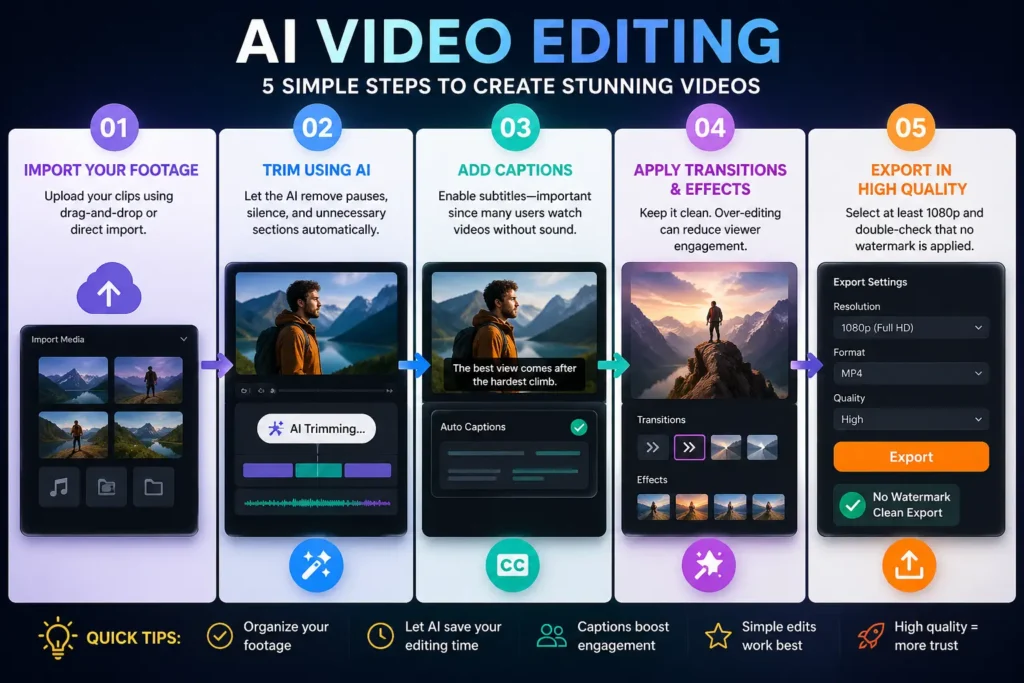
Here’s a simple workflow you can follow:
1. Import Your Footage (Start With Organized Inputs)
This is where your editing process begins.
Most modern editors allow:
- Drag-and-drop uploads from your desktop
- Direct import from your device, cloud storage, or even mobile
What Actually Matters Here
- Keep your files organized before importing
- Rename clips if needed (especially for longer videos)
- Upload all assets at once (video, audio, images, logos)
Why it’s important:
A messy import leads to a messy timeline. Spending 2–3 minutes organizing here can save 20+ minutes later.
2. Trim Using AI (Save the Most Time Here)
This is where AI makes the biggest difference.
Instead of manually cutting every mistake, the tool can:
- Detect silence or pauses
- Remove filler words (“uh”, “um”)
- Cut out retakes automatically
What to Watch For
- Review AI cuts before finalizing
- Sometimes it can trim too aggressively
Real-world benefit:
For talking videos, this step alone can reduce editing time by more than half.
3. Add Captions (Boost Engagement Instantly)
Captions are no longer optional—they’re a performance factor.
Many viewers:
- Watch without sound
- Scroll quickly and rely on text to stay engaged
What AI Does Here
- Auto-generates subtitles
- Syncs them with speech
- Allows quick editing for accuracy
Why This Matters
- Improves watch time and retention
- Makes content accessible to a wider audience
Simple insight:
Videos with captions often hold attention longer, especially on mobile.
4. Apply Transitions & Effects (Less is More)
This is where many creators go wrong.
AI tools can suggest:
- Scene transitions
- Effects based on clip changes
- Visual enhancements
Best Approach
- Use clean cuts or minimal transitions
- Apply effects only where they add clarity or emphasis
What to Avoid
- Overusing animations
- Adding unnecessary effects between every clip
Why it matters:
Over-editing can distract viewers and reduce retention. Simple edits usually perform better on YouTube.
5. Export in High Quality (Final Step That Defines Output)
This step determines how your video looks to your audience.
Recommended Settings
- Resolution: At least 1080p (Full HD)
- Format: MP4 (widely supported)
- Frame Rate: Match your original footage
Critical Check
- Ensure no watermark is added
- Double-check export settings before finalizing
Why This Step Is Crucial
- Poor export quality reduces perceived professionalism
- High-quality output improves viewer trust and retention
Important note:
Even a well-edited video can fail if exported in low quality.
Free vs Paid AI Video Editing Tools
| Feature | Free AI Tools | Paid AI Tools |
| Watermark | Not always (depends on tool) | No watermark |
| AI Features | Basic automation (captions, trimming) | Advanced AI (voice cloning, smart editing) |
| Export Quality | Up to 1080p (most cases) | 4K / 8K supported |
| Templates & Assets | Limited access | Premium libraries |
| Performance & Speed | May vary on device | Optimized performance |
| Best For | Beginners & small creators | Professionals & businesses |
For most creators, free tools are enough to get started. Paid versions make sense only when your workflow demands more control or higher output quality.
Common Mistakes to Avoid
1. Skipping Export Checks (Small Mistake, Big Impact)
Many creators assume their video is ready once editing is done—but export settings can change everything.
What Actually Happens
Some tools:
- Add a watermark by default
- Only remove it under certain settings (resolution, templates, login)
- Reset export preferences after updates
Why It’s a Problem
You might:
- Finish editing perfectly
- Export the video
- Realize too late that branding is added
👉 This wastes time and can delay uploads.
What to Do Instead
- Always do a quick test export
- Double-check:
- Watermark settings
- Resolution (1080p or higher)
- Format (MP4 recommended)
Simple rule: Never hit publish without reviewing your final output.
2. Overusing Effects (Looks Good to You, Not to Viewers)
This is one of the most common beginner mistakes.
What Over-Editing Looks Like
- Transitions between every clip
- Excessive animations
- Too many zooms, filters, or overlays
Why It Hurts Your Video
- Distracts from your message
- Makes content feel cluttered
- Reduces viewer retention
👉 On YouTube, clarity beats complexity.
Better Approach
- Use clean cuts as your default
- Add effects only when they:
- Highlight something important
- Improve storytelling
Practical insight:
Most high-performing YouTube videos are edited simply—not heavily.
3. Ignoring Performance (Your Tool Slows You Down)
Not all editing software runs smoothly on every device.
What Happens in Real Use
- Laggy timeline
- Slow rendering
- Crashes during editing
Why This Matters
- Breaks your workflow
- Increases editing time
- Makes consistency harder
👉 A powerful tool isn’t useful if it’s frustrating to use daily.
What to Do Instead
- Choose software that matches your system
- If your device is limited:
- Use lighter editors
- Lower preview quality while editing
Key idea:
Speed and stability matter more than advanced features.
4. Neglecting YouTube SEO (The Most Overlooked Factor)
Even a perfectly edited video won’t perform without visibility.
What Many Creators Miss
They focus only on editing and ignore:
- Titles
- Thumbnails
- Keywords
- Descriptions
Why This Is Critical
YouTube is a search platform. If your video isn’t optimized:
- It won’t get discovered
- It won’t reach the right audience
What to Focus On
- Write clear, keyword-focused titles
- Create click-worthy thumbnails
- Add relevant tags and descriptions
Important insight:
Editing improves quality—but SEO drives traffic.
Tips to Create Better YouTube Videos Using AI
- Capture attention in the first 5 seconds
- Use captions to improve accessibility and retention
- Keep edits clean and purposeful
- Maintain consistent branding across videos
A simple but effective insight: videos with clear subtitles tend to perform better on mobile, where most viewers scroll without sound.
Conclusion
Creating high-quality YouTube videos no longer requires expensive software or advanced editing skills.
With the right tools, you can produce clean, professional content using some of the best free AI video editing tools available—without worrying about watermarks or complicated workflows.
The key is simple: pick one tool, learn it well, and stay consistent.
If you’re starting today, choose a tool from this list and create your first video. Taking action matters more than waiting for perfection.
Because in the long run, growth on YouTube isn’t about having the most advanced editor—it’s about showing up regularly with content that delivers value.
Consistency beats complexity—every single time.
Frequently Asked Questions (FAQs)
1. Is there a completely free AI video editor without a watermark?
Yes, several tools offer watermark-free editing. Popular options include CapCut, VN Video Editor, and DaVinci Resolve, which allow clean exports in their free versions under standard settings.
2. Which is the easiest AI video editor for beginners?
The easiest AI video editors for beginners are Clipchamp and Canva. They offer simple drag-and-drop interfaces, ready-made templates, and minimal learning curves, making them ideal for first-time creators.
3. Can I use a free AI video editor for monetized YouTube videos?
Yes, most free AI video editors allow commercial use, including monetized YouTube content. However, you should always review the tool’s licensing terms to ensure there are no restrictions on usage.
4. Do free AI video editing tools support 4K export?
Some free AI video editing tools support 4K export, but many limit it to paid plans. Free versions typically offer 1080p exports, which is sufficient for most YouTube videos.
5. Are AI video editors better than traditional editing software?
AI video editors are faster and easier to use, especially for beginners, as they automate tasks like trimming and captions. However, traditional software still offers more control for advanced editing and professional projects.