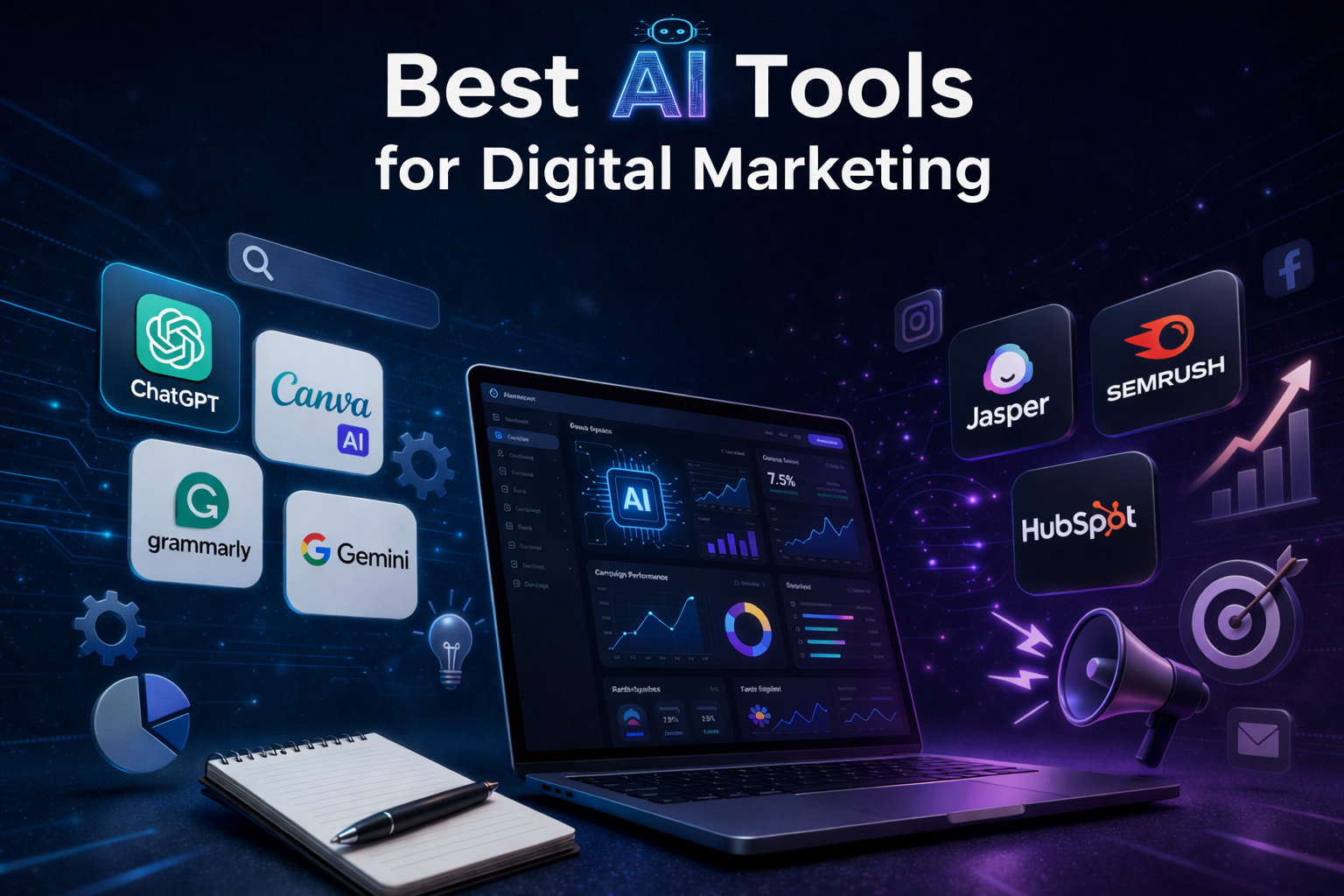
Digital marketing today doesn’t look anything like it did a few years ago. What used to take hours writing content, analyzing campaigns, designing creatives can now be done much faster with the help of artificial intelligence. That’s why AI tools for Digital Marketing are quickly becoming a core part of every marketer’s toolkit.
If you’ve ever felt overwhelmed managing multiple marketing tasks, you’re not alone. This is exactly where smart tools step in. They simplify complex processes, reduce manual work, and help you focus on what actually matters: strategy and growth.
Whether it’s understanding your audience better or automating repetitive tasks, these tools are helping businesses make smarter decisions backed by data.
What Are AI Tools for Digital Marketing?
In simple terms, these are tools powered by intelligent systems that help you plan, execute, and improve your marketing efforts.
Instead of relying purely on manual work, these tools use technologies like:
- Machine Learning (ML): Learns from data and improves over time
- Natural Language Processing (NLP): Understands and generates human-like text
- Generative AI: Creates content like blogs, images, and videos
What makes them powerful is how they quietly handle the heavy lifting in the background. From analyzing customer behavior to suggesting better campaign strategies, they allow marketers to work more efficiently without sacrificing quality.
Benefits of Using AI in Digital Marketing
Using AI in marketing offers clear advantages that directly impact business growth.
Here’s what actually improves:
- You spend less time on repetitive tasks
- Content becomes more consistent and polished
- Targeting feels more precise instead of guesswork
- Campaign decisions are backed by real data
- You can react quickly to changing trends
For example, instead of manually writing every piece of content, you can generate a solid draft in minutes and refine it. Similarly, campaign performance can be tracked and optimized almost instantly.
Categories of AI Tools for Digital Marketing
Understanding these categories helps you pick the right tools based on your marketing goals whether it’s content creation, SEO, or automation.
1. AI Content Creation Tools
AI content tools are designed to generate written content automatically. They use advanced language models to create human-like text for blogs, ads, emails, and more.
How They Work:
These tools rely on Natural Language Processing and Generative AI to understand prompts and produce relevant content.
What They Can Do:
- Write blog posts and articles
- Create ad copy and product descriptions
- Generate social media captions
- Draft email campaigns
Popular Tools:
- ChatGPT
- Jasper
Real Use Case:
A digital marketer can generate a 1000-word blog post in minutes instead of hours, saving time and effort.
Why It Matters:
- Speeds up content production
- Maintains consistency
- Reduces dependency on manual writing
2. AI SEO & Optimization Tools
These tools help improve your website’s visibility on search engines like Google by analyzing data and suggesting optimizations.
How They Work:
They use Machine Learning to study search trends, keywords, and competitor strategies.
What They Can Do:
- Find high-ranking keywords
- Optimize content for SEO
- Analyze competitors
- Improve on-page SEO
Popular Tools:
- Surfer SEO
- SEMrush
Real Use Case:
You can optimize a blog post to rank on Google by following keyword suggestions and content guidelines.
Why It Matters:
- Improves search rankings
- Increases organic traffic
- Helps create SEO-friendly content
3. AI Design & Creative Tools
These tools help create visual content automatically, even if you don’t have design skills.
How They Work:
They use Generative AI to generate images, graphics, and designs from text prompts.
What They Can Do:
- Design social media posts
- Create banners and thumbnails
- Generate AI images and illustrations
- Build ad creatives
Popular Tools:
- Canva
- MidJourney
Real Use Case:
A marketer can create Instagram posts or ad creatives in minutes without hiring a designer.
Why It Matters:
- Saves design costs
- Speeds up content creation
- Ensures professional-quality visuals
4. AI Social Media Marketing Tools
These tools help manage and automate social media activities efficiently.
How They Work:
They analyze audience behavior and engagement patterns to schedule and optimize posts.
What They Can Do:
- Schedule posts automatically
- Suggest best posting times
- Track engagement and performance
- Manage multiple accounts
Popular Tools:
- Buffer
- Hootsuite
Real Use Case:
You can plan and schedule an entire week’s content in one sitting.
Why It Matters:
- Saves time
- Improves consistency
- Boosts audience engagement
5. AI Email Marketing Tools
These tools help create and manage personalized email campaigns at scale.
How They Work:
They use data analysis and automation to send the right message to the right audience at the right time.
What They Can Do:
- Automate email campaigns
- Segment audiences
- Personalize email content
- Track open and click rates
Popular Tools:
- Mailchimp
- HubSpot
Real Use Case:
An e-commerce brand can send personalized product recommendations to customers automatically.
Why It Matters:
- Improves customer engagement
- Increases conversion rates
- Saves manual effort
6. AI Analytics & Automation Tools
These tools focus on data analysis, insights, and automation to improve marketing performance.
How They Work:
They use predictive analytics and machine learning to identify patterns and trends in user behavior.
What They Can Do:
- Track website traffic and performance
- Predict customer behavior
- Optimize campaigns in real-time
- Generate detailed reports
Popular Tools:
- Google Analytics
- HubSpot
Real Use Case:
You can track which campaigns bring the most conversions and optimize accordingly.
Why It Matters:
- Provides data-driven insights
- Improves decision-making
- Maximizes ROI
Top 10 Generative AI Tools for Marketers
Here are the Top 10 generative AI tools that are widely used:
- ChatGPT – Content writing and brainstorming
- Jasper – Marketing copy and blogs
- Copy.ai – Ad copy and product descriptions
- Writesonic – SEO content creation
- MidJourney – AI image generation
- DALL·E – Creative visuals
- Canva AI – Design automation
- Synthesia – AI video creation
- Pictory – Video summarization
- Runway ML – Video editing and effects
These tools are transforming how marketers create and deliver content, making Generative AI a powerful asset in modern strategies.
Also know more about:
Overview of Artificial Intelligence: Definition, Types, Applications & Future
Top 10 Machine Learning Applications Transforming Industries in 2026 and more
Best Free AI Tools for Digital Marketing
If you’re just starting in digital marketing, free tools can help you create content, design visuals, and improve strategy without any upfront cost. Let’s break down how each tool works and where it fits.
1. ChatGPT
What it does:
An AI-powered chatbot that helps generate text-based content quickly.
How marketers use it:
- Write blog posts, product descriptions, and ad copy
- Generate social media captions and ideas
- Create email marketing content
- Brainstorm campaign strategies
Example:
If you’re launching a product, you can ask it to generate:
- Instagram captions
- Ad headlines
- SEO blog outlines
Why it’s useful: Saves hours of writing time and boosts productivity.
2. Canva AI
What it does:
A beginner-friendly design platform with AI features for creating visuals.
How marketers use it:
- Design social media posts, banners, and ads
- Create presentations and marketing materials
- Use AI to generate images and layouts
Example:
You can create:
- Instagram posts
- YouTube thumbnails
- Blog banners
Why it’s useful: No design skills required—everything is drag-and-drop.
3. Grammarly
What it does:
An AI writing assistant that improves grammar, clarity, and tone.
How marketers use it:
- Fix grammar mistakes in blogs and emails
- Improve readability and professionalism
- Adjust tone for different audiences
Example:
Turn a basic sentence into a polished marketing message instantly.
Why it’s useful: Helps create high-quality, error-free content.
4. Google Gemini
What it does:
An AI tool for research, insights, and content generation.
How marketers use it:
- Conduct keyword and topic research
- Generate blog ideas and outlines
- Analyze trends and user intent
Example:
You can ask it:
- “Trending topics in digital marketing”
- “Content ideas for SEO blog”
Why it’s useful: Great for research and planning strategies.
Limitations of Free AI Tools
While free tools are powerful, they do come with some restrictions:
Limited Features
- Advanced capabilities (automation, integrations) are often locked behind paid plans
- Output quality may be slightly lower than premium versions
Usage Restrictions
- Daily or monthly limits on usage
- Slower processing during peak times
Less Automation
- Free tools require more manual input
- Paid tools offer workflows, scheduling, and deeper integrations
Best Paid AI Tools for Digital Marketing
Paid tools are ideal for businesses and professionals who want better performance, automation, and scalability. Let’s break down each tool:
1. Jasper – Advanced Content Creation
Jasper AI is a powerful writing assistant designed specifically for marketing content.
What it does:
- Generates blog posts, ad copy, email campaigns, and landing pages
- Uses AI to match tone, style, and brand voice
- Helps create long-form and short-form content quickly
Key Features:
- Pre-built templates for ads, blogs, and product descriptions
- SEO-friendly content generation
- Multi-language support
Why marketers use it:
It saves hours of writing time and ensures consistent, high-quality content—especially useful for agencies and content teams.
2. Surfer SEO – On-Page Optimization
Surfer SEO helps improve your content ranking by analyzing top-performing pages on search engines.
What it does:
- Provides keyword suggestions based on real-time SERP data
- Optimizes content structure (headings, keywords, length)
- Gives a content score to measure SEO performance
Key Features:
- Content Editor with real-time recommendations
- Keyword density and NLP suggestions
- Competitor analysis
Why marketers use it:
It ensures your content is optimized for ranking, making it easier to appear on the first page of search results.
3. HubSpot – Full Marketing Automation
HubSpot is an all-in-one platform that manages marketing, sales, and customer relationships.
What it does:
- Automates email marketing campaigns
- Tracks customer interactions and behavior
- Manages leads and sales funnels
Key Features:
- CRM integration
- Email automation and workflows
- Analytics and reporting dashboard
Why marketers use it:
It centralizes all marketing activities in one place, making it easier to manage campaigns and improve customer engagement.
4. SEMrush – Keyword & Competitor Analysis
SEMrush is one of the most popular tools for SEO and competitive research.
What it does:
- Finds high-ranking keywords
- Analyzes competitor strategies
- Tracks website performance and backlinks
Key Features:
- Keyword research tools
- Site audit reports
- Traffic and ranking analysis
Why marketers use it:
It provides deep insights into what competitors are doing, helping you build better strategies and outrank them.
Advantages of Paid AI Tools
1. Higher Accuracy
Paid tools use advanced algorithms and updated data, delivering more reliable results compared to free versions.
2. Advanced Automation
They automate complex tasks like:
- Email sequences
- Content optimization
- Campaign tracking
This reduces manual work and increases efficiency.
3. Better Scalability for Businesses
Paid tools are designed to handle:
- Large campaigns
- Multiple users
- High data volumes
Perfect for agencies, startups, and growing businesses.
Free vs Paid AI Tools (Comparison)
| Feature | Free Tools | Paid Tools |
| Cost | Free | Subscription-based |
| Features | Limited | Advanced |
| Accuracy | Moderate | High |
| Automation | Basic | Advanced |
If you’re a beginner, start with free tools. For businesses, paid tools offer better long-term value.
How to Choose the Right AI Tool (Step-by-Step Guide)
Selecting the right tool isn’t about picking the most popular option—it’s about choosing what actually fits your workflow, goals, and budget. Here’s how to do it smartly:
1. Define Your Marketing Goals
Before choosing any tool, be clear about what you want to achieve.
Ask yourself:
- Do you want to generate blog content?
- Improve SEO rankings?
- Automate social media posting?
- Run better ad campaigns?
Example:
If your goal is content creation, tools like ChatGPT or Jasper are ideal.
If your focus is SEO, then SEMrush is more suitable.
Tip: Never choose a tool without a clear goal—it leads to wasted time and money.
2. Set a Realistic Budget
AI tools come in both free and paid versions, but pricing varies widely.
Consider:
- Monthly subscription costs
- Hidden costs (add-ons, credits, API usage)
- ROI (Will it help you earn/save more than it costs?)
Example:
- Beginners can start with free tools like Canva
- Businesses may benefit more from premium tools like HubSpot
Tip: Start small, then upgrade as your needs grow.
3. Compare Features and Usability
Not all tools offer the same features. Some are simple, while others are complex and feature-rich.
Look for:
- Ease of use (beginner-friendly or advanced?)
- Features relevant to your work
- Speed and performance
- Quality of output
Example:
A beginner may prefer Canva (drag-and-drop), while an expert might prefer advanced tools with automation and analytics.
Tip: Don’t go for “too many features”—focus on what you actually need.
4. Check Integrations with Existing Tools
Your AI tool should work smoothly with your current software stack.
Check if it integrates with:
- CRM systems
- Email marketing tools
- Social media platforms
- Analytics tools
Example:
HubSpot integrates with email, CRM, and analytics—making it powerful for businesses.
Why it matters:
Good integration = less manual work + better automation.
5. Try Free Trials Before Committing
Never buy a tool without testing it first.
During the trial, evaluate:
- Is it easy to use?
- Does it meet your needs?
- Is the output quality good?
- Does it actually save time?
Most tools offer:
- Free plans
- Trial periods (7–14 days)
Tip: Test 2–3 tools before deciding—comparison helps you choose better.
9. Future of AI in Digital Marketing
The future of marketing is closely tied to artificial intelligence.
Key Trends:
- Increased automation in campaigns
- Growth of AI-generated content
- Hyper-personalization for users
- Smarter ad targeting and optimization
AI-powered advertising is growing rapidly, showing strong adoption across industries. Businesses that adapt early will gain a clear competitive edge.
Conclusion
Artificial intelligence is no longer a futuristic concept, it’s the driving force behind smarter, faster, and more profitable marketing strategies. From creating high-quality content to analyzing customer behavior in real time, modern tools are helping businesses unlock growth like never before.
If you want to stay ahead in today’s competitive landscape, adopting AI tools for Digital Marketing is a must. Brands that leverage these technologies are already outperforming their competitors by delivering personalized experiences, optimizing campaigns, and maximizing ROI with precision.
The best part? You don’t need a huge budget to get started. Begin with free tools, experiment with different platforms, and gradually scale as your needs grow. The earlier you embrace this shift, the stronger your digital presence will become.
Don’t wait to start using AI today and transform your marketing strategy into a powerful, results-driven machine.
Frequently Asked Questions (FAQ’s)
1. What are the best AI tools for digital marketing?
Some of the best tools include ChatGPT, Jasper, Canva AI, SEMrush, and HubSpot.
2. Are free AI tools enough for beginners?
Yes, free tools are great for beginners, but they may have limitations in features and scalability.
3. Which AI tool is best for SEO?
Surfer SEO and SEMrush are among the top choices for SEO optimization.
4. Can AI replace digital marketers?
No, AI supports marketers but cannot replace human creativity and strategy.
5. How do AI tools improve marketing ROI?
They automate tasks, provide data insights, and optimize campaigns, leading to better performance and higher returns.