Let’s be honest-blogging in 2026 isn’t what it used to be.
A few years ago, people started blogs as online diaries. Today, it has become one of the most practical ways to build a real income online. I’ve seen beginners go from zero traffic to consistent earnings just by following the right strategy and staying consistent.
If your goal is to start a blog and earn money blogging, you don’t need to be a tech expert or a professional writer. What you need is clarity, patience, and a system that actually works.
In this guide, I’ll walk you through:
- How to build a blog from scratch
- How to attract real traffic
- How to turn your blog into a reliable income source
If you’re exploring blogging for beginners’ money, this guide will give you a realistic and actionable path—without false promises.
Why Blogging is Still Profitable in 2026
1. People Trust Blogs More Than Ever
Before buying anything or learning something new, most people search online. Blogs that provide clear, helpful answers still dominate search results.
2. AI Has Made Blogging Faster (But Not Easier)
Yes, AI tools can help you write faster—but they can’t replace real experience. The blogs that win today are the ones that combine AI efficiency with human insight.
3. It Builds Long-Term Passive Income
Here’s something most beginners don’t realize:
One well-written blog post can bring traffic for years.
Unlike social media posts that disappear in hours, blogs keep working in the background—bringing visitors, leads, and income.
4. Multiple Ways to Earn
Blogging is not limited to one income source. You can earn through:
- Affiliate links
- Ads
- Selling your own products
- Offering services
That’s what makes it powerful and scalable.
Step-by-Step Guide to Start a Blog in 2026
Step 1 – Choose a Profitable Blog Niche
This is where most beginners go wrong.
Instead of choosing a niche randomly, think about:
- What people are searching for
- What problems you can solve
- What you can consistently write about
Evergreen vs Trending
- Evergreen niches (finance, health) give long-term stability
- Trending niches (AI, tech) give quick growth
The smart move? Combine both.
Profitable Niche Ideas
- Personal finance
- AI & tools
- Health & fitness
- Travel
- Online income
Real Tip: When I started, I tried writing about everything—and got nowhere. Growth started only when I focused on one clear topic.
Step 2 – Pick a Domain Name & Hosting
Your blog name is your brand. Don’t overcomplicate it.
Simple Rules
- Keep it short
- Make it easy to remember
- Avoid numbers and symbols
Hosting Matters More Than You Think
A slow website can kill your growth before it even starts.
Look for:
- Fast loading speed
- Strong security
- Reliable uptime
Think of hosting as the foundation of your blog.
Step 3 – Set Up Your Blog (No Coding Needed)
You don’t need technical skills anymore.
Platforms like WordPress make everything simple.
Why Most Beginners Choose WordPress
- Easy to use
- SEO-friendly
- Highly customizable
Basic Setup Checklist
- Install a clean theme
- Add essential plugins
- Make your site mobile-friendly
Over 70% of users visit blogs on mobile—don’t ignore this.
Step 4 – Design Your Blog for Better Experience
Design is not about making your blog “look pretty.”
It’s about making it easy to use.
Focus On
- Clean layout
- Simple navigation
- Fast loading pages
Must-Have Pages
- About (builds trust)
- Contact (for opportunities)
- Privacy Policy (important for ads approval)
A confusing blog loses visitors in seconds.
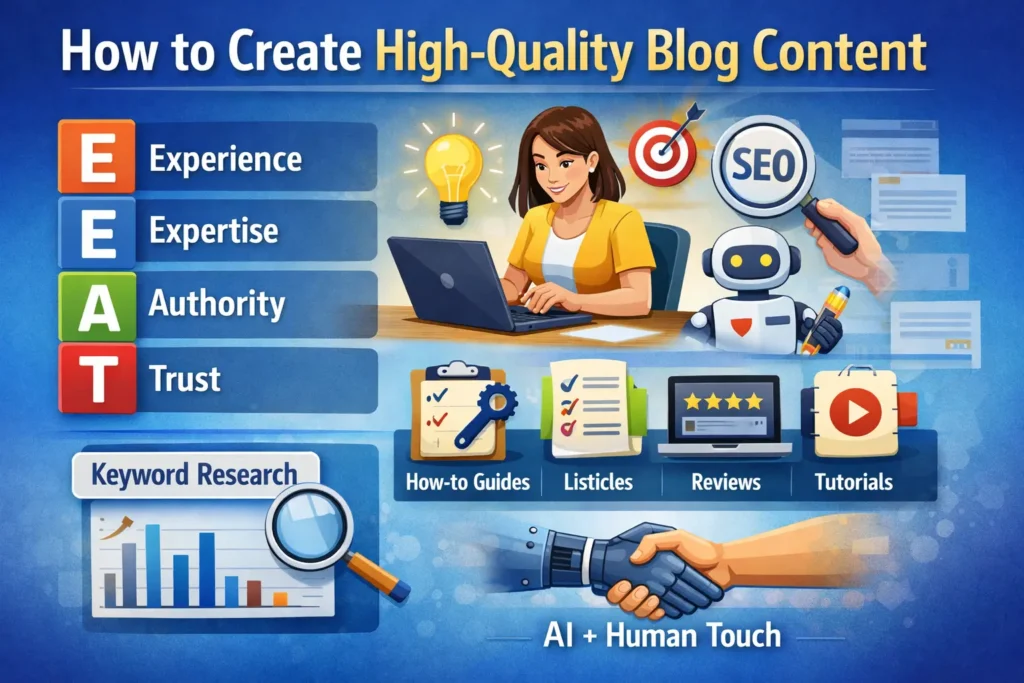
How to Create High-Quality Blog Content
This is where real success happens.
Focus on EEAT (This is Critical)
Google ranks content that shows:
- Real experience
- Clear expertise
- Authority in the topic
- Trustworthiness
Instead of writing “what everyone says,” try sharing:
- What worked for you
- What didn’t
- What beginners should avoid
Simple Content Strategy That Works
- Answer real questions
- Keep language simple
- Write for humans, not just search engines
Content Types That Perform Well
- Step-by-step guides
- List-based articles
- Honest reviews
- Tutorials
Using AI Without Sounding Like AI
AI can help you:
- Generate ideas
- Speed up writing
But here’s the truth:
If you don’t edit and personalize it, your blog will sound like everyone else.
Always:
- Add your own voice
- Simplify sentences
- Remove robotic phrases
SEO Strategies to Rank Your Blog in 2026
If content is the engine, SEO is the fuel.
On-Page SEO Basics
- Use your keyword naturally
- Write clear titles
- Add internal links
Technical SEO Essentials
- Fast website
- Secure (HTTPS)
- No broken links
Core Web Vitals Matter
Google now prioritizes:
- Speed
- Stability
- User experience
Modern SEO Trends
- Voice search optimization
- Answer-based content
- Intent-focused writing
Don’t just target keywords—solve problems.
Backlinks Still Matter
The easiest ways:
- Guest posting
- Writing valuable content
- Networking with bloggers
How to Drive Traffic to Your Blog
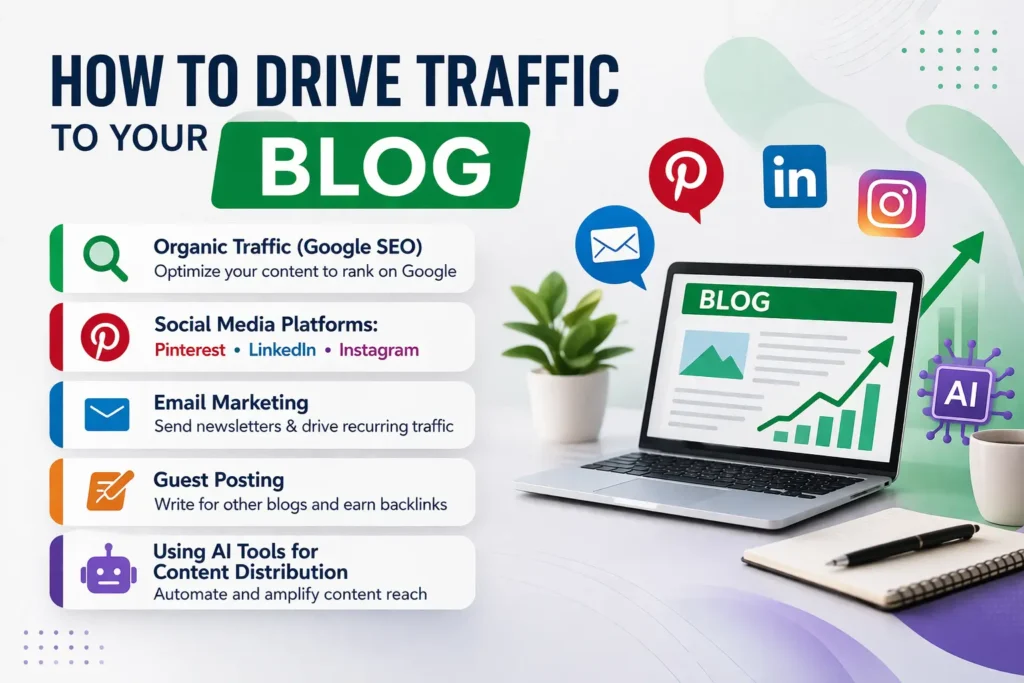
Traffic is what turns your blog into income.
1. SEO (Best Long-Term Strategy)
Focus on ranking articles—it takes time but gives consistent results.
2. Social Media
- Pinterest → best for blog traffic
- LinkedIn → professional audience
- Instagram → brand building
3. Email Marketing
Start early—even with 10 subscribers.
4. Guest Posting
Write on other blogs to build authority.
Best Ways to Earn Money from Blogging
1. Affiliate Marketing (Best for Beginners)
What it means:
You promote someone else’s product and earn a commission when someone buys through your link.
How it works:
- You join an affiliate program (like Amazon, hosting companies, tools, etc.)
- You get a unique tracking link
- You add that link in your blog (reviews, guides, recommendations)
- When someone clicks and buys → you earn money
Example:
Let’s say you write: “Best Blogging Tools for Beginners”
You recommend:
- Hosting service
- SEO tools
- WordPress themes
If a reader clicks your link and buys → you earn commission.
Why it’s great for beginners:
- No need to create your own product
- Easy to start
- High earning potential
2. Ads (Passive Income)
What it means:
You display ads on your blog and earn money when visitors see or click them.
How it works:
- You apply to ad networks (like Google AdSense)
- Ads automatically appear on your site
- You earn:
- Per click (CPC)
- Per 1000 views (CPM)
Example:
If your blog gets:
- 10,000 visitors/month → small income
- 100,000 visitors/month → significant income
Important:
- Ads need traffic to make money
- Low traffic = low earnings
This is why ads are usually a later-stage strategy
3. Digital Products (High Profit Model)
What it means:
You create your own product and sell it directly to your audience.
What you can sell:
- Ebooks (guides, tutorials)
- Online courses
- Templates (resumes, designs, planners)
How it works:
- You create a product once
- Sell it multiple times
- Keep 90–100% profit
Example:
If you have a blog about blogging:
You can sell:
- “Beginner Blogging Course”
- “SEO Checklist PDF”
Why it’s powerful:
- No middleman
- Scalable income
- Builds authority
4. Sponsored Content (Brand Deals)
What it means:
Companies pay you to write about their product or service.
How it works:
- Brands contact you (or you reach out)
- They pay you to:
- Write a review
- Feature their product
- Add backlinks
Example:
A hosting company may pay you:
₹5,000 – ₹50,000+ per article (depends on traffic)
Best for:
- Blogs with good traffic
- Niche authority websites
5. Freelancing (Fastest Way to Earn Early)
What it means:
You offer services using your blog as a portfolio.
Services you can offer:
- Content writing
- SEO services
- Website setup
- Consulting
How it works:
- A visitor reads your blog
- They trust your knowledge
- They hire you
Example:
If you write SEO blogs:
A business might contact you: “Can you do SEO for my website?”
Why it’s powerful:
- You can start earning even with low traffic
- High income potential
Which One Should YOU Start With?
If you’re a beginner:
- Start with Affiliate Marketing
- Add Freelancing (quick income)
- Then scale with:
- Ads
- Digital products
- Sponsored posts
Simple Strategy (Most Important)
Don’t try all at once.
Start like this:
- Month 1–3 → Content + SEO
- Month 3–6 → Affiliate + Freelancing
- Month 6+ → Ads + Products
How Much Can You Earn from Blogging in 2026?
Here’s a realistic breakdown:
| Level | Monthly Earnings | Time Required |
| Beginner | $0 – $100 | 0–3 months |
| Intermediate | $500 – $2000 | 6–12 months |
| Advanced | $5000+ | 1+ year |
Blogging rewards consistency—not shortcuts.
Common Blogging Mistakes to Avoid
1. Choosing a Random Niche
What this means:
Many beginners pick a topic randomly just because:
- It sounds profitable
- Others are doing it
- It’s trending
Why it’s a problem:
If you don’t understand or enjoy the niche:
- You’ll run out of ideas quickly
- Content will feel forced
- You’ll quit early
Better approach:
Choose a niche where:
- People are searching (demand exists)
- You have at least some interest or curiosity
Example:
Don’t just pick “crypto” because it’s trending.
Pick something like “beginner crypto guides” if you can explain it simply.
2. Ignoring SEO
What this means:
You write blog posts without:
- Keywords
- Proper headings
- Optimization
Why it’s a problem:
Even great content won’t rank if Google can’t understand it.
Result:
- No traffic
- No visibility
- No income
Better approach:
Before writing, ask:
- What are people searching?
- Can I solve that clearly?
Example:
Instead of writing: “My Blogging Journey”
Write: “How to Start a Blog in 2026 (Step-by-Step Guide)”
3. Posting Inconsistently
What this means:
- Writing 5 blogs in one week
- Then disappearing for a month
Why it’s a problem:
- Google prefers fresh, consistent content
- Readers forget your blog
Blogging is like going to the gym—consistency beats intensity.
Better approach:
Set a realistic schedule:
- 2 blogs per week OR
- 1 high-quality blog per week
Consistency builds trust + rankings.
4. Relying Fully on AI
What this means:
Copy-pasting AI-generated content without editing.
Why it’s a problem:
- Content feels robotic
- Lacks real experience
- Google may not rank it
In 2026, AI content alone is NOT enough.
Better approach:
Use AI as a helper, not a writer:
- Generate ideas
- Structure content
- Then add your own voice
Think:
AI = assistant
YOU = creator
5. Writing Without Understanding User Intent
What this means:
You write what you want, not what the reader needs.
Why it’s a problem:
Even if you rank, users will:
- Leave quickly
- Not engage
- Not convert
Most blogs fail not because of lack of effort—but lack of direction.
Simple Summary (Remember This)
| Mistake | Real Problem | Fix |
| Random niche | No consistency | Choose interest + demand |
| Ignoring SEO | No traffic | Do keyword research |
| Inconsistent posting | No growth | Follow schedule |
| Overusing AI | Low quality | Add human touch |
| Ignoring intent | Low engagement | Solve real problems |
Tools You Need to Grow Faster
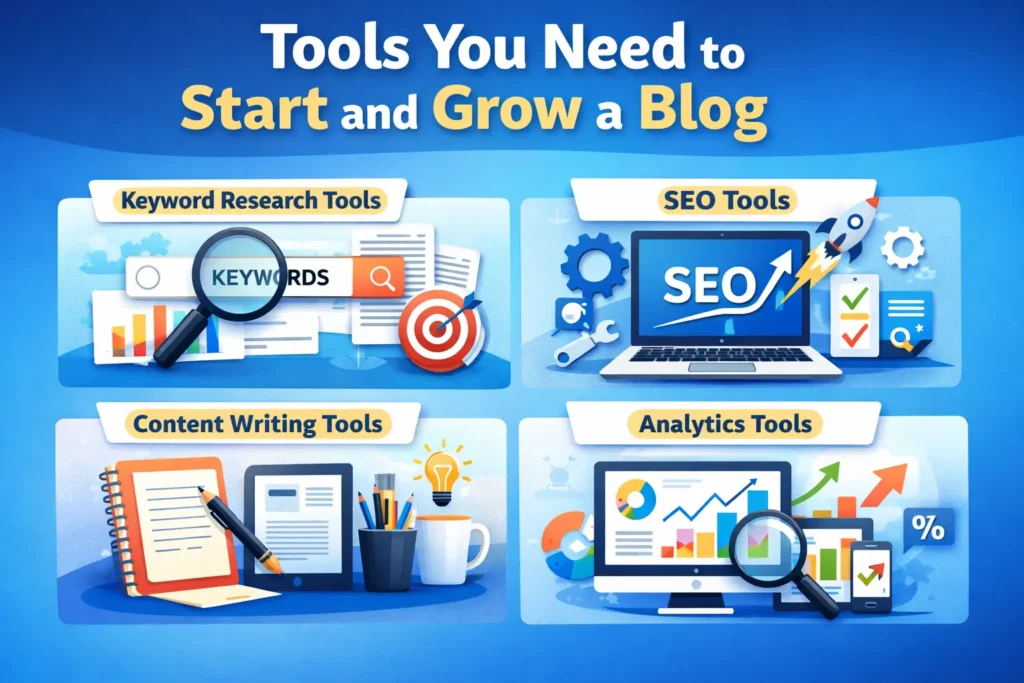
1. Keyword Research Tools (Finding What People Search)
These tools help you understand:
What people are searching on Google
Instead of guessing topics, you create content based on real demand.
What They Do
- Show search volume (how many people search a keyword)
- Show competition level
- Suggest related keywords
Example
Instead of writing: “How to blog”
You discover: “how to start a blog and earn money blogging”
This gives you higher chances of ranking
Popular Tools
- Ubersuggest
- Ahrefs
- SEMrush
- Google Keyword Planner
Simple Tip:
Always choose keywords with:
- Medium/low competition
- Clear user intent
2. SEO Optimization Tools (Helping You Rank Higher)
These tools guide you to optimize your blog properly for Google.
What They Do
- Suggest keyword placement
- Improve readability
- Check SEO score
- Help fix errors
Why It Matters
Even good content won’t rank if it’s not optimized.
Popular Tools
- Yoast SEO
- Rank Math
- Surfer SEO
Simple Tip:
Focus on:
- Title optimization
- Headings (H1, H2, H3)
- Internal linking
3. Writing Assistants (Improve Content Quality)
These tools help you write clean, clear, and engaging content.
What They Do
- Fix grammar mistakes
- Improve sentence clarity
- Suggest better wording
Why It Matters
Good writing = more engagement = better rankings
Popular Tools
- Grammarly
- QuillBot
- ChatGPT
Important Tip: Don’t rely fully on tools—always add your own voice and experience
4. Analytics Tools (Tracking Your Growth)
These tools tell you:
What’s working and what’s not
Without analytics, you’re just guessing.
What They Show
- How many visitors you get
- Which pages perform best
- Where traffic comes from
- User behavior
Popular Tools
- Google Analytics
- Google Search Console
Example Insight
You might discover: One blog post is getting 80% of your traffic
Then you can:
- Update it
- Add affiliate links
- Improve SEO
Simple Tip:
Check your data weekly—not daily (avoid overthinking)
Simple Summary (Easy to Remember)
| Tool Type | Purpose | Why It Matters |
| Keyword Tools | Find topics | Helps you rank |
| SEO Tools | Optimize content | Improves visibility |
| Writing Tools | Improve quality | Boosts engagement |
| Analytics Tools | Track performance | Helps you grow |
The right tools don’t guarantee success—but they save time.
Future of Blogging in 2026 and Beyond
Blogging is evolving, not dying.
What’s Changing
- AI + human collaboration
- Voice and visual search
- Personalized content
What Stays the Same
People will always search for helpful, real content.
Conclusion: Start Now, Not Later
If you’ve been waiting for the “right time,” this is it.
To start a blog and earn money blogging, you don’t need a perfect plan—you just need to begin. Most successful bloggers didn’t have everything figured out on day one. They started, learned, and improved along the way.
Start small. Publish your first post. Stay consistent.
Because in blogging, success doesn’t come to the smartest—it comes to those who keep showing up.
A year from now, you could have a blog generating real income—but only if you take that first step today.
Frequently Asked Questions (FAQs)
Q1: Can I start a blog with no money in 2026?
Yes, but investing a small amount gives better results.
Q2: How long does it take to make money?
Usually 6–12 months with consistent effort.
Q3: Which niche is best?
Finance, AI, health, and online income are strong choices.
Q4: Do I need technical skills?
No, modern tools make it beginner-friendly.
Q5: Is blogging still worth it?
Yes—if done with the right strategy.